
In an elegant park in Paris, among clean paths, expensive coats, and golden leaves, Madeleine had been waiting on a bench for almost an hour. She held a small fabric bag against her, worn by the years, and watched every passerby as if one of them might still return her family to her.
Her son, Adrien, finally arrived. Dark suit, phone in hand, hurried gaze. Beside him walked his wife, Camille—impeccable, cold, with that polite smile reserved for strangers.
“Mom, we don’t have much time,” Adrien said without kissing her.
Madeleine stood up slowly. She had prepared simple words. She only wanted to tell him that she felt lonely, that the apartment was too quiet, that Sundays without him were becoming heavy.
But Camille glanced at the bag.
“You brought something again?”
Madeleine lowered her head.
“Little slippers I knitted… for the baby.”
Silence fell.
Camille let out a short, dry laugh.
“That’s kind, but our child won’t wear that.”
Adrien said nothing. And that silence hurt more than the words.
Madeleine clutched the bag to her chest. For thirty years, she had given everything to her son: her savings, her nights, her youth. She had worked in a bakery at dawn, then cleaned offices in the evening so he could study, succeed, live in a world where now she seemed too poor to exist.
“I just wanted to be there,” she whispered.
Adrien sighed.
“Mom, you have to understand. Our life has changed.”
Then Madeleine gently opened her bag. Beneath the tiny slippers was an old envelope. She handed it to her son.
“Your life changed because of this.”
Adrien opened it, annoyed. Then his face turned pale.
It was the receipt from the sale of the family house. The house Madeleine had secretly sold twenty years earlier to pay for his studies abroad. The one where she could have grown old peacefully. The one she had sacrificed for him.
Camille stopped smiling.
Adrien looked up. For the first time in a long while, he did not see an annoying old woman. He saw his mother.
“Why did you never tell me?” he asked in a broken voice.
Madeleine answered softly:
“Because a sacrifice given with love should not become a debt.”
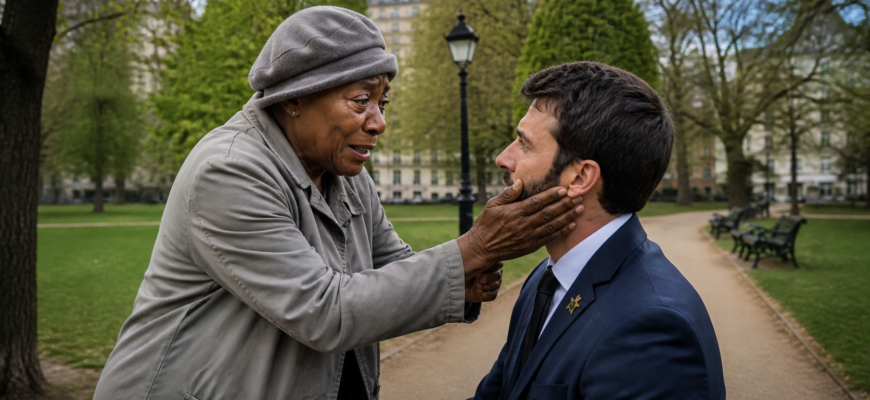
Adrien cried in front of the passersby. He took his mother’s hands, then the slippers, and pressed them to his heart.
That evening, Madeleine did not go home alone. Her son walked her back, stayed for dinner, and returned the following Sunday.
The baby wore the slippers when it was born.
And in the park, on that bench, Madeleine understood that it was not too late to mend a forgotten love.