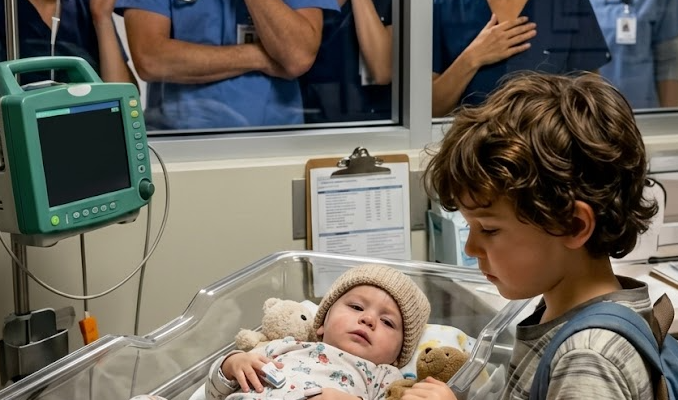

In the intensive care room, there was such deep silence that every sound from the medical equipment seemed deafening. Several doctors stood silently around the child’s crib, staring tensely at the monitor where a thin green line was moving more and more slowly. Little Alex, the five-month-old son of Daniel Reid, owner of one of the country’s largest construction companies, had not responded for a long time to voices, touch, or attempts to stabilize his condition. The clinic’s best specialists looked exhausted. Over the past few hours, they had used everything modern medicine could offer. Rare medications, expensive equipment, urgent tests, consultations with leading experts — nothing was helping. With every passing hour, it became harder to breathe not only for the child, but also for the adults, who were beginning to realize they were losing control of the situation.
The boy’s mother, Evelyn, sat against the wall, tightly clutching a handkerchief soaked with tears. From time to time, she looked up at her son as if hoping he would open his eyes at any moment, then lowered her head again. Daniel stood motionless by the window, like a statue. One of the most influential men in the city, accustomed to solving every problem with money, connections, and power, now looked like a completely helpless man facing something he could not control for the first time in his life.
The chief doctor removed his glasses with a tired motion and quietly said:
— We checked everything we could. The results are clear, the scans show nothing critical. It’s as if the problem is too small to notice, and yet it’s exactly what’s preventing the child from breathing normally.
Evelyn raised her tearful face and whispered almost inaudibly:
— Please… don’t give up…
No one answered. A heavy silence filled the room, carrying the exhaustion of people who had nearly run out of options. At that very moment, the door slowly opened.
A thin boy of about ten appeared in the doorway, dressed in an old gray jacket and worn sneakers. On his back, he carried a huge, torn backpack stuffed with plastic bottles. He looked as though he had accidentally wandered into a world completely different from his own.
A security guard immediately stepped forward.
— Hey, you’re not allowed in here.
A nurse frowned irritably.
— Please take him out immediately.
But the boy awkwardly raised the hand holding a black wallet.

— I… wanted to return this.
Daniel turned around and immediately recognized his wallet. He had lost it that morning near the business center by the parking lot, but because of the rush and fear for his son, he hadn’t even noticed it was missing. Inside were money, bank cards, documents, and a large amount of cash. Anyone in the boy’s position could have simply kept everything for themselves.
But the boy named Noah had grown up under very different circumstances. He lived with his grandfather in an old railway car near the tracks, collecting bottles and scrap metal to help them survive, and from an early age he had heard one simple sentence from his grandfather:
— A poor man must be more attentive than others. Sometimes the smallest details decide fate.
Noah had walked almost across the entire city to return the wallet to its owner. Already at the clinic, he accidentally overheard doctors talking about the billionaire’s child, and before he realized it, he found himself standing near the room.
Evelyn nervously said to the security guard:
— First check if everything is inside.
But at that moment Noah suddenly froze and looked at the child so carefully, as if trying to understand something very important. For several seconds he remained silent, paying no attention to the doctors or security, and then cautiously stepped closer to the crib.
The chief doctor said irritably:
— Boy, don’t interfere while the doctors are working.
But Noah seemed not to hear him. He kept staring at the right side of the baby’s neck, where beneath the skin a tiny bump was barely visible. So small that the adults had simply overlooked it among dozens of tests and complicated medical terms.
Finally, the boy quietly said:
— That doesn’t look like a tumor.
The doctors looked at each other in surprise.
— What did you say? — one of them asked.
Noah swallowed nervously and carefully pointed with his finger.
— Once my grandfather choked on a fish bone, and his neck looked almost the same… only here something is much smaller.
The chief doctor frowned.
— We ran tests. There’s nothing there.

But Noah suddenly asked quietly:
— What if the object is transparent?
After those words, silence once again filled the room, but this time it felt different. One of the doctors quickly turned toward the screen, another requested that the child’s airways be examined again from a different angle, and within seconds the specialists noticed something they had not seen before.
Deep inside the child’s airway, a thin transparent piece of plastic from a pacifier was lodged. On the scans, it blended almost completely with the surrounding tissue, which was why the equipment had practically failed to detect it.
The room immediately burst into motion. A doctor quickly prepared the instruments and carefully performed the procedure. Everyone froze in anticipation. It seemed as though even the machines had become quieter for a moment.
Several endlessly long seconds passed.
Then suddenly, the monitor displayed a steady, stable rhythm.
The baby took a deep breath.
Evelyn suddenly covered her mouth with her hands and burst into tears, this time from relief. One of the doctors collapsed heavily into a chair, still unable to believe that the cause had turned out to be both so tiny and so obvious.
Daniel slowly walked over to Noah and looked at him for a long time, as if trying to understand how a boy who had almost nothing managed to notice what the best specialists had overlooked.
Finally, he quietly asked:
— You saved my son… but why did you decide to return the wallet in the first place?
Noah shrugged calmly, as if the answer were completely simple.
— Because it didn’t belong to me.
After those words, silence filled the room once again, but this time it was no longer heavy.