My stepfather raised me from the age of four. I will never forget what he whispered to me in the hospital before he died.
“The pancakes always had the shape of little stars,” I told the nurse as she adjusted the light blanket over Dennis’s legs.
“Even when I was thirty-five, married, and raising a daughter, he still brought out that ridiculous metal mold.”
Dennis opened his eyes.
He had slept all day. His breathing was quiet and uneven, but now his gaze settled on me. I waited for his familiar crooked smile.
Instead, tears appeared in his eyes.
I moved closer to the bed.
“Dad?”
His lips moved, but no sound came out.
“Does it hurt?”
He shook his head.
The nurse looked at the monitor and touched my shoulder.
“I’ll leave you two alone for a moment.”
When she left, I took a damp towel from the cabinet and placed it on his forehead.
“You know, those pancakes were never particularly tasty,” I said, trying to bring back old memories. “They always burned around the edges.”
He quietly, almost with a laugh, exhaled.
“And you ate them anyway.”
“Of course. I was afraid that otherwise you’d make me eat oatmeal.”
Dennis married my mother when I was four. At first, I didn’t want to call him anything at all. Not Dennis. Not Dad. Nothing.
When he asked whether I wanted toast, I would simply point silently at the bread. When he offered to read to me before bed, I would hide under the covers.
My biological father disappeared from my life before I was old enough to remember him, and even at four years old I firmly believed one thing: men who came into the house carrying a suitcase could not be trusted.
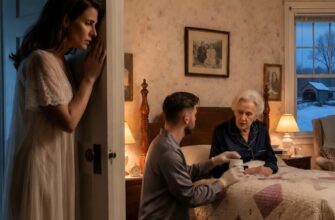
Dennis never tried to force his way into my life. He simply noticed that I liked strawberry jam spread all the way to the edges of my toast. During thunderstorms, he would sit in the hallway outside my door because I wouldn’t let him come inside. And every Sunday, he made apple pancakes, cutting them out with an old metal star-shaped mold.
One morning, almost three months after the wedding, I walked into the kitchen and, without even realizing it, called him Dad.
Dennis dropped the spatula.
Neither of us showed that anything had happened. He simply placed a pancake with the least-burned edges on my plate.
Five months later, my mother died. An aneurysm — everything happened so suddenly that our last ordinary conversation had been an argument about whether I had put my shoes away.
The house quickly filled with relatives. They whispered in corners, glancing at Dennis when they thought I couldn’t hear them.
“He’s not her biological father.”
“Her aunt could take her.”
“He’ll want to start a new life.”
The night after the funeral, I hid under the kitchen table, pulling my knees to my chest. Dennis found me before dawn. Without asking why I was hiding, he sat down beside me on the floor.
“Are you going to leave?” I whispered.
His face twisted as if I had struck him.
“No.”
“Everyone leaves.”
“I won’t.”
“Promise?”
He held out his little finger.
“I promise.”
And he kept that promise.
Many years later, he was the one who walked me down the aisle. When my daughter was baptized, he stood beside me and held her head so carefully, as if, despite being thirty-two years old, I might somehow drop her.
Whenever I asked about his life before he met my mother, he always answered:
“What matters began when you came into my life, sweetheart.”
I always thought those were words of love. It never occurred to me that there might be something more behind them.
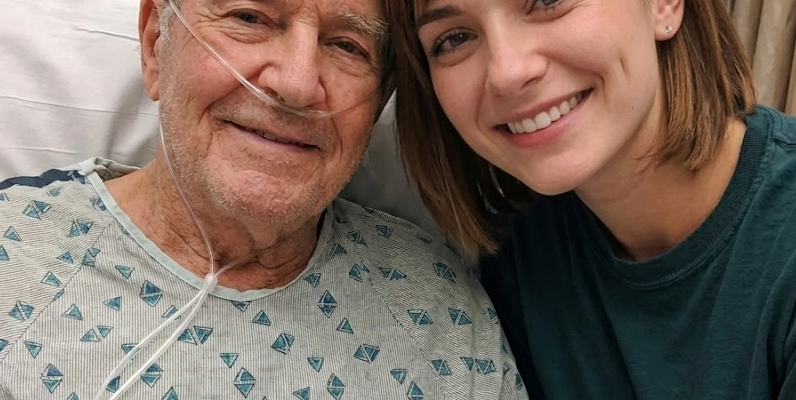
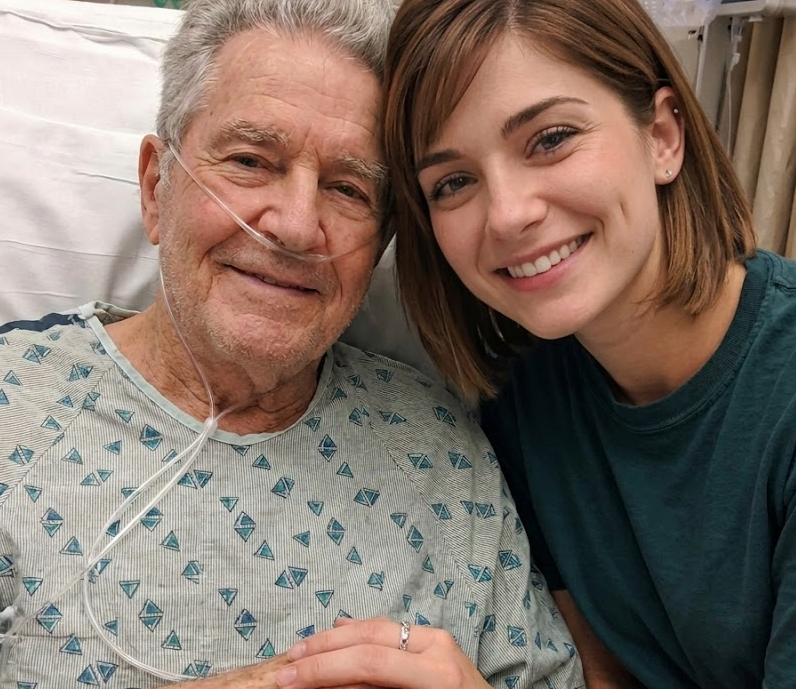
Dennis’s health began to deteriorate shortly after his seventy-eighth birthday. First came unusual fatigue. Then weight loss. Then tests, doctors, and those careful words people use when they already know how everything will end.
For the last week, I had slept in an armchair beside his hospital bed, waking at every change in his breathing.
Last night, the doctor asked me to step into the hallway.
“He probably has a few hours left, Abigail.”
I nodded. I couldn’t speak. I was afraid I would burst into tears.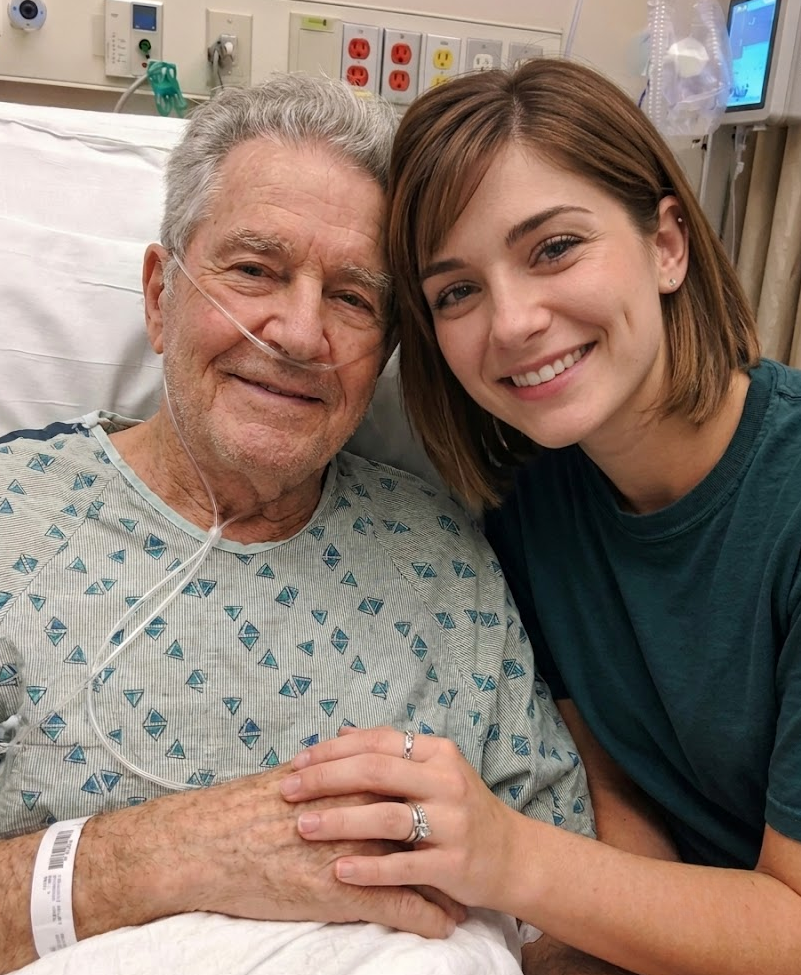
When I returned to the room, Dennis looked as though he were asleep. I sat in the armchair and took his hand in mine.
Suddenly, he tightened his fingers around my hand. Hard.
“Promise me you’ll listen to me before you hate me,” he said suddenly.
I froze.
“I could never hate you.”
His hand was cold.
“I’ve lied to you my entire life.”
I tried to smile.
“Dad, you’re just tired. Should I call the nurse?”
“My mind is clear.” He tightened his grip. “Everything you think about your childhood, about me… it’s only part of the truth.”
My heart began beating faster.
“What are you talking about?”
“You need to know the truth while I’m still alive, even though I was begged to take it with me to the grave.”
Questions began spinning through my mind. Was my biological father alive? Did Dennis have another family? An entire hidden life?
With trembling fingers, he pulled a folded piece of paper from beneath the blanket and placed it in my hand.
“Go there. Immediately.”
“I can’t leave you.”
“You have to.” Tears rolled down his gray stubble. “Please, Abigail.”
He hadn’t called me that since I was a child.
“Tell me yourself,” I pleaded, leaning closer.
He closed his eyes.
“Some truths have to be told by someone else.”
Those were his last words.
When the monitor began beeping, the nurse came in and checked his pulse.
“He’s still with us,” she said, “but he may not wake up again.”
In the hallway, I unfolded the paper. In Dennis’s trembling handwriting was an address — less than twenty minutes away from the house where he had raised me.
I almost threw the paper away. Whatever was waiting at that address couldn’t possibly be more important than the man dying in the hospital room. But I remembered his expression — it wasn’t fear of death, but fear that I would never understand him.
I sped through nearly empty streets, imagining all kinds of betrayals along the way: a secret wife, a stranger who would tell me Dennis had never wanted me.
An elderly woman with gray hair and pale blue eyes opened the door. When she saw me, she covered her mouth with her hand as though she had seen a ghost.
“Abigail,” she whispered.
“How do you know me?”
“My name is Patricia. Dennis called me a month ago. He said that one day you might come here.”
She let me inside.
“Please tell me what he lied to me about.”
Without a word, Patricia went to a kitchen drawer and took out a set of metal cookie cutters: hearts, flowers, animals, apples — and one small star.
I couldn’t breathe. It was an exact copy of the one Dennis had used every Sunday throughout my childhood.
“Where did you get it?”
“It belonged to Dennis. He had two of them, sweetheart.”
Beneath the cutters was an old photograph: a little girl about five years old standing beside the kitchen table, holding a plate of star-shaped pancakes. Behind her, a young, thin Dennis smiled in a way I had never seen him smile before.
“Who is that?”
“Her name was Hayley,” Patricia said in a trembling voice. “Dennis was married before your mother. Hayley was his daughter. She drowned in a lake when she was five years old. It was an accident. Dennis blamed himself, even though there was nothing he could have done. After that, his marriage fell apart. He shut himself away and hid all the photographs, toys — everything that reminded him he had been a father.”
I sat down in the chair. My legs could no longer support me.
“Why didn’t he tell me?”
“One day, not long after he married your mother, you fell asleep in his lap. When you woke up, you asked whether he knew how to make star-shaped pancakes. He called me that very same day, crying. For the first time in many years, he said Hayley’s name out loud and didn’t break down.”
“You didn’t replace his daughter,” Patricia added. “You gave him a way to remember her without being afraid that the memory would destroy him.”
“So what was the lie?”
Patricia looked away.
“After your mother died, Dennis packed his things into the car. He decided your aunt should raise you. He said that staying with you would be selfish. He came here the night after the funeral and sat in this kitchen until dawn, repeating, ‘Every time Abigail laughs, I hear Hayley. Every time she runs toward the street, my heart stops beating. I won’t survive if I have to bury another daughter.’”
Pain tightened around my chest.
“He promised me he would stay.”
“He made that promise only after he nearly left,” Patricia said quietly. “I told him not to run away from his love for you, but to stay precisely because he already loved you. He returned home before you woke up, thanked your aunt, and then crawled under the kitchen table to make you that promise.”
I covered my face with my hands. All my life, I had thought I was the one who needed him. It turned out that he had almost run away because he was terrified of losing another child.
“Why did he hide this from me?”
“Because he didn’t want you to feel responsible for keeping him alive,” Patricia answered, wiping away her own tears. “He didn’t want a child to carry the weight of an adult’s pain. He saved you. But you saved him too.”
I raced back to the hospital, with Hayley’s photograph lying on the seat beside me. A nurse stood outside his room. Her face told me everything before she managed to say a single word.
“I’m so sorry, your father…”
I walked past her. The room was silent — there was no longer the sound of oxygen, his uneven breathing, or the monitor beeping.
I took his cold hand and pressed it against my cheek.
“You should have told me,” I whispered. “You should have given me the chance to thank you, Dad.”
The nurse brought me a bag containing his belongings: keys, a watch, a worn wallet. Inside, behind his driver’s license, was the old photograph of Hayley with the pancakes. And behind it was another: me, five years old, holding a crooked, burnt pancake and grinning from ear to ear.
Neither photograph had been labeled. Dennis carried both of his daughters close to his heart every day. He hadn’t replaced Hayley with me — he loved me while remembering what it meant to lose a child.
That evening, I returned home. My daughter was waiting for me at the kitchen table.
“Will Grandpa come back?”
“No, sweetheart.”
I hugged her and held her until my tears finally stopped. Then I opened the drawer beside the stove. Deep inside was the old star-shaped mold, darkened by decades of Sunday breakfasts.
I prepared the batter — flour, eggs, milk, cinnamon, and pieces of apple — and poured it into the little metal star.
“Mom, why did Grandpa always make them like that?”
I looked at the two photographs standing beside the stove.
“Because someone once taught him that love can remember one person — and still find room for another.”
We sat at the table. My daughter took a bite of the pancake and laughed — the same laugh that had once frightened Dennis. And the same laugh that eventually taught him not to run away.
When breakfast was over, I put the mold back beside the stove. It would be there next Sunday. And every Sunday after that.
Not because the grief had passed.
But because love had finally become big enough to hold it all.